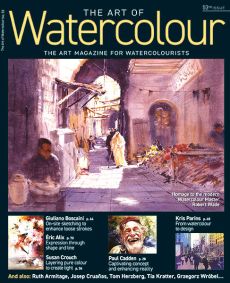
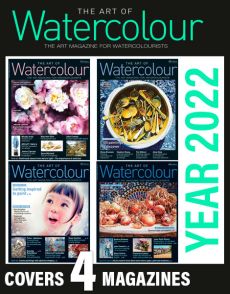
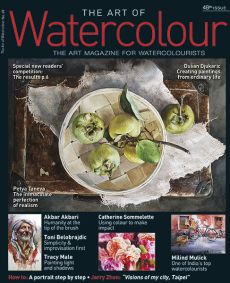
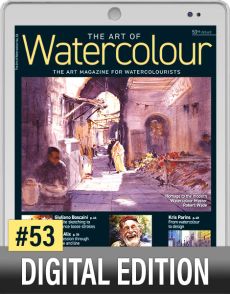
Browse an extract from this issue:
CONTENTS:
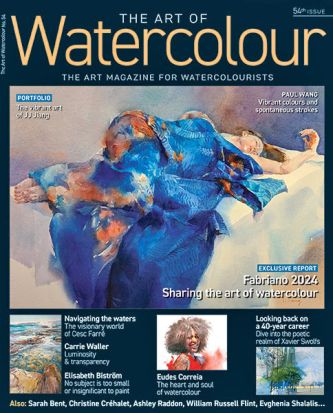
Cesc Farré: His captivating watercolours show vibrant compositions inspired by the sea, the skies and the light of the seaside.
Xavier Swolfs: A poetic realm where the transparency of water converges with the depth of human emotion and spontaneity and introspection blend seamlessly.
Carrie Waller: Explore her expert advice on mastering intricate, luminous and transparent compositions while preserving captivating visual coherence.
Konstantin Sterkhova: Discover how he captures the pulsating energy of urban life, revealing hidden stories and fleeting emotions.
Evghenia Shalalis: In her urban landscapes, the delicate dance between light and shadow ignites the imagination, offering a distinctive and captivating visual narrative.
Elisabeth Biström: The Swedish artist reveals her fascination with water as a central theme, along with her open and inquisitive approach to colour and technique.
Sarah Bent: In her almost abstract landscapes, she blends inspired spontaneity with technical mastery to create works brimming with emotion and depth.
Paul Wang: Discover his unique approach to storytelling with watercolour sketches, where vibrant colours and spontaneous brushstrokes breathe life into architectural scenes.
Christine Créhalet: She finds boundless inspiration in nature’s beauty, sharing her artistic journey, the significance of painting en plein air and the profound connection between artist and landscape.
Eudes Correia: From his early inspirations to his distinctive techniques, Correia shares his passion and creative process.
Portfolio : Ji Jiang.
Eastern and Western influences harmoniously merge to create rich and evocative paintings infused with poetry, spirituality and a profound affinity for water.
Special New Readers’ Competition: The results of our “Capturing light in a summer scene” themed contest.
Competition winners: Ruth Andrews-Vreeland, Ashley Raddon, Kevin Clifford.
What’s on: Watercolour events from all over the world.
Special report: Fabriano 2024, sharing the art of watercolour.
History of art: William Russell Flint (1880-1969).
Call for entries
EDITORIAL
In his book on Johan Barthold Jongkind published in 1927, Paul Signac writes: “Watercolour is merely a means of notation, a kind of memorandum, a rapid and fertile process enabling a painter to enrich his repertoire with elements too transient to be fixed by the slow process of oil painting. A cloudy sky is a magnificent whole, but one that is perpetually distorted”. These words resonate like a distant echo of the traditional approach to watercolour, once regarded as a simple tool for capturing the ephemeral and sketching fleeting impressions. As we all know, things are very different today. Over the decades, the approach to watercolour has undergone a radical transformation. It has become an art form in its own right, embracing a wide range of styles and techniques, from hyperrealism to abstraction and pushing the boundaries of artistic expression. Today, artists use watercolour to create works of astonishing diversity, from Arcadian landscapes to vibrant portraits, from abstract compositions to detailed illustrations. To convince yourself of this, simply look at the list of artists featured in the latest issue of The Art of Watercolour. Whether it’s Xavier Swolfs’ tireless exploration of new media, Carrie Waller’s chiaroscuro still lifes, or Paul Wang’s lively brushwork as he navigates the bustling streets of Vietnam, each artist has found in watercolour a means of capturing and sharing their unique vision of the world, transcending cultural boundaries and individual differences.
Watercolour has become a versatile medium, capable of capturing the complexity of the world around us and the infinite nuances of the human experience. It also serves as a bridge, connecting shared passions, as demonstrated by the vibrant gatherings at events like the Breizh Aquarelle Biennial in Brittany and Fabriano InAcquarello in Italy. Hugo Pratt, another great Italian artist, once wrote: “A watercolour is not a story, it is the translation of a sensation, a memory, a state of mind.” These words perfectly capture the essence of watercolour: a form of artistic expression that transcends words, embodying the very core of our humanity with simple, captivating beauty. Happy reading.
The editorial team.